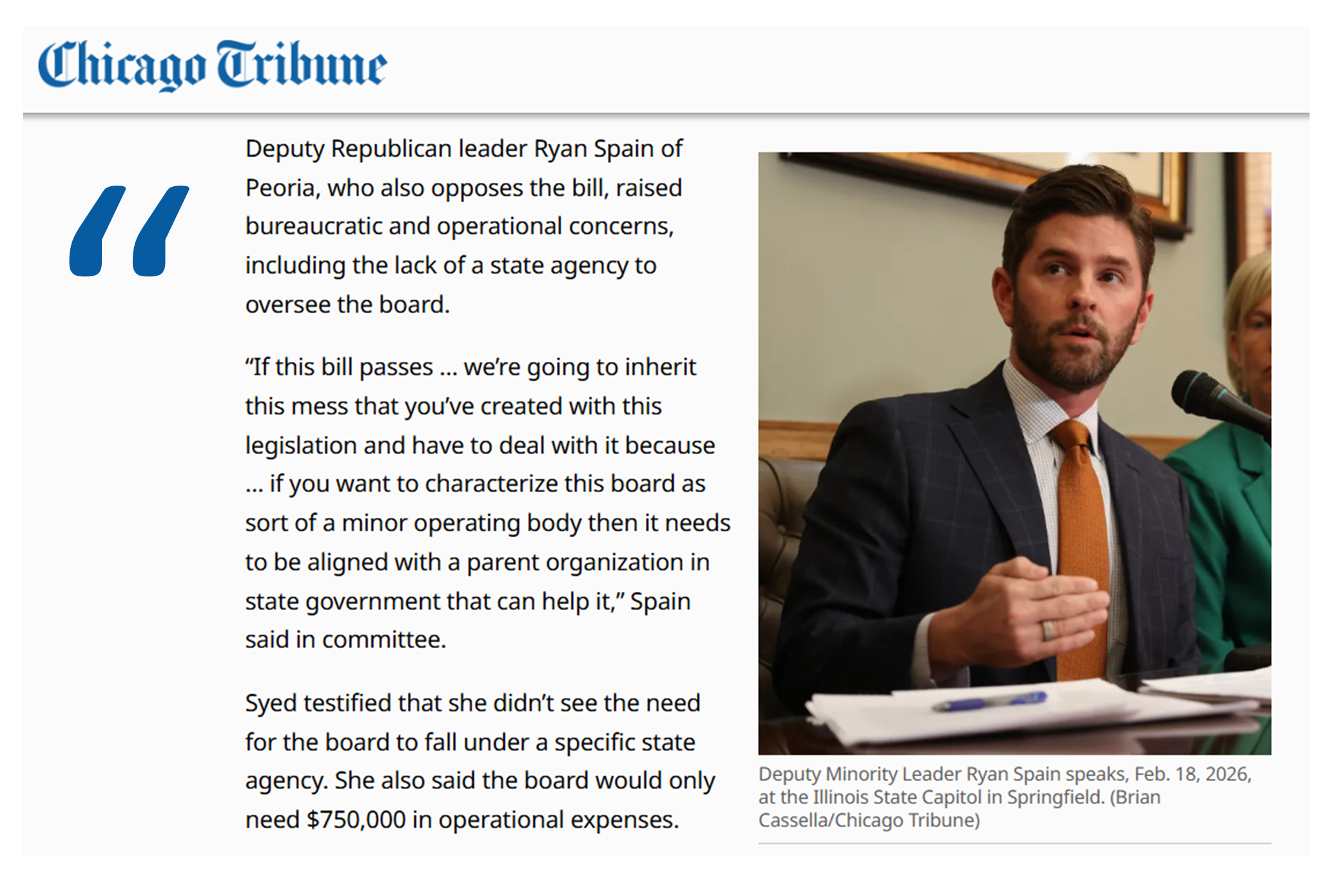
Speaking out against a haphazard prescription price control bill passed in the Illinois House Executive Committee and on the House Floor, State Representative Ryan Spain raised bureaucratic and operational concerns, including the lack of a state agency to oversee the board.
“If this bill passes … we’re going to inherit this mess that you’ve created with this legislation and have to deal with it because … if you want to characterize this board as sort of a minor operating body then it needs to be aligned with a parent organization in state government that can help it,” Spain said in committee.
Representative Spain is not only the Republican Spokesperson of the powerful House Executive Committee, he is Co-Chairman of the bicameral, bipartisan Joint Committee on Administrative Rules, and is one of the legislatures’ top experts on the Administrative Rules process utilized to take bills from legislative intent to executive agency implementation.
If created, the five-member board — appointed by the governor — would have authority to evaluate the cost of most prescription drugs, determine whether prices are unreasonably high and set upper payment limits, essentially capping what consumers pay. Pharmaceutical companies would have the opportunity to justify their prices before a cap is set. The board would also be charged with improving access to medication, particularly in rural and low-income communities.
A central focus of the legislation is tying Illinois drug prices to Medicare’s new negotiating power under the 2022 Inflation Reduction Act. Beginning this year, Medicare — which covers people 65 and older and those with disabilities — negotiated lower prices for 10 high-cost drugs. The results for Januvia, a diabetes medication, meant a drop from $527 to $113 for a 30-day supply, while Enbrel, used to treat rheumatoid arthritis, fell from $7,106 to $2,355, according to the Centers for Medicare & Medicaid Services.
Under the proposed bill, those Medicare-negotiated rates would automatically become the upper payment limits for Illinois consumers across all healthcare plans. Medicaid and certain state employee health insurance programs would, for technical reasons, need to opt in separately.
The board would not be permitted to further cut prices on drugs already negotiated through Medicare but could work to ensure those drugs reach patients who need them.
A spokesperson for Democratic Gov. JB Pritzker would not say whether the governor supports creating a prescription drug board, other than to say his office is reviewing the proposal.